What should you consider when selecting a Management System Consultant?
You’ve decided to develop and implement a management system within your organisation, and have come to the view that there is benefit in engaging outside help, which often means finding a consultant to work with your organisation towards your objective.
When I say the objective, in my view this means developing a framework of processes and practices that meet requirements of various stakeholders (referred to as interested parties in the ISO standards), and add value to the organisation.
This objective may or may not include ISO certification, and the decision of whether or not to be certified should not be the ultimate goal. I’ve seen plenty of examples of poorly designed and implemented management systems that somehow continue to remain ISO certified, though which provide absolutely zero benefit to the organisation.
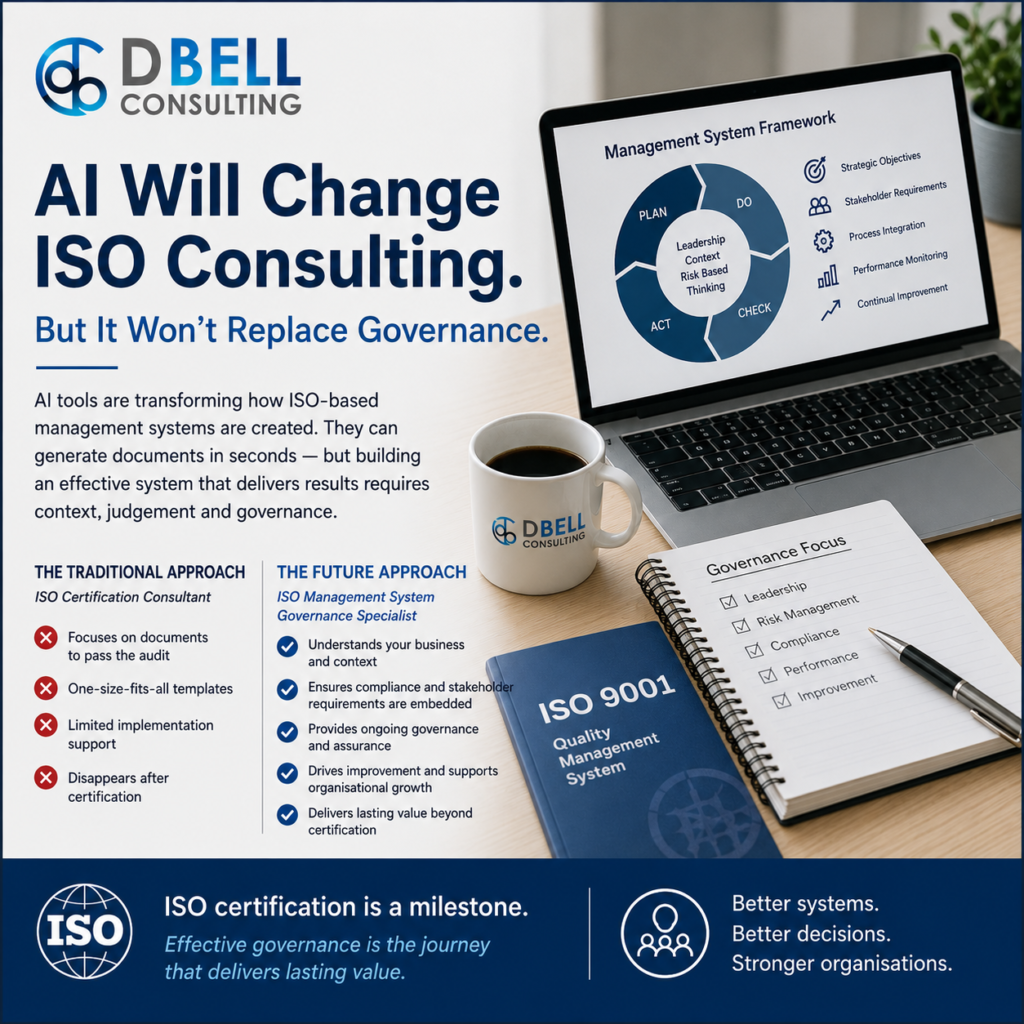
So, what does this have to do when choosing a consultant? Well, quite a lot as a matter of fact. There are consultants that are primarily focused on helping you tick enough boxes to get certified, and after this is achieved they generally disappear into the ether (upon payment of their final invoice). On the other hand, when you select a consultant with a wider perspective of the term ‘value’, you will ultimately gain much more from the experience. You’ll end out developing a management system that is fit-for-purpose, and will serve the organisation well into the future.
Consultant Assessment and Selection Criteria
A tailored approach specific to the Organisational context
Though the ISO management system standards provide a consistent structure and framework for management system design and content, be wary of consultants that simply aim to provide you with a set of templated processes with an “insert company name and logo here” instruction.
A management system should reflect many features and attributes of the organisation that it values, which need to be considered within the system’s design and implementation. This can include:
- The history of the organisation, and how this currently influences the organisation in the present;
- The range of product and service offerings, and how the organisation is structured to deliver these;
- Important aspects of the organisation’s culture and values, particularly how it identifies and works with its stakeholders;
- How the organisation differentiates itself from its competitors or contemporaries; and
- What the organisation aims to achieve in the future.
The nature of the ISO standards do provide the basis for consistency in management system design, though this is only to a point, so it’s important to understand that your management system should demonstrate an element of your organisation’s own personality.
There’s much more that I could list here, but this illustrates the point.
Support to understand and interpret ISO requirements
Developing a management system is as much a training exercise for the client as much as it involves the development of processes and procedures.
Depending on the degree to which the organisation has previously worked with ISO management system standards, the organisation may need assistance from the consultant to understand the intent of ISO requirements, how to interpret these in the organisation’s own context, and guidance with how to apply the requirements.
Having a clear understanding of the requirements of the standards means that you’ll have a much better result of working with a consultant. This can involve:
- Purchasing copies of the standards (consider this a minimum), and taking the time to work through these to understand the requirements. The certification auditor(s) will understand these documents, so the least you can do is develop your own knowledge.
- Finding a consultant that will work with you to help you understand not only what’s written in the standard, but can help you understand the intent behind the requirements, and how to apply the requirements within your organisational context.
- Receiving guidance to external resources that enable you to gain an understanding of the ISO standards. This can involve training courses, websites and blogs.
Whilst the ISO standards aren’t frequently updated, you’ll need to stay abreast of any changes, as this will likely impact your obligations to retain certification. A recent example were the updates to the main ISO standards regarding the need to be aware of any potential impacts to the organisation from climate change.
Project planning, communication and progress
Setting consultant and client expectations right at the start of a management system project is a critical aspect of developing trust and mutual respect. Achieving the objective of developing a fit-for-purpose management system is contingent on:
- A clearly defined, and easy to follow Project Plan.
- A timeline that is established around a target, though has the ability to recognise changes in the face of new information or requirements.
- A regimen of regular interactions between the consultant and the organisation to ensure that deliverables are being achieved according to the Project Plan, and to address any unexpected issues that arise along the way.
A common question when a new client is wanting to develop a management system is ‘How long does it take?“. Being able to set up a model that addresses the above points gives a sense of confidence that the consultant can meet the organisation’s expectations.
Requirements for Information Management
There are many moving parts to an ISO-based management system, and how you manage processes, registers, records and notifications is a critical aspect of its success (not to mention communication).
Your management system will involve information relating to asset management, employee competency, customised workflow management, contractor management (if relevant), document management, operational risk management, hazard and incident reporting, and more.
Choosing the right software platform will reduce the administrative demands of the management system, and free up your people to attend to other demands on their time.
There are heaps of products out there, so take the time to find one that is aligned with your needs.
Shameless plug – the partnership between DBell Consulting and Ideagen EHS means that we can deliver a complete solution that provides the perfect marriage between consulting services and value-added software that you’ll enjoy using.
Project Cost and Investment
I’ve purposely left this one to the end, as it’s clearly going to be an issue for most organisations – “What’s this going to cost?“.
The cost of developing a management system will involve:
- The consultant’s fee – yes, this will be something that needs to be considered, and your consultant should be able to provide an estimate at the very least. Personally, I don’t provide a fixed fee, as there’s too many variables outside of my control, though I’m yet to exceed an estimate that the client wasn’t comfortable with.
- Your own time and effort. I’ll say to my clients that the amount of time and effort that I put into designing and developing your management system will be the minimum amount of time that they’ll need to invest themselves. After all, isn’t this a system that they need to understand an use?
- Development and training costs for the organisation’s own people should be considered, as you’re going to need your people to own the management system, and they can’t use what they don’t understand.
- Certification audits and associated fees will be charged by your certification body (also known as a Conformity Assessment Body). Get at least 3 fully costed proposals before making a decision, and involve your consultant in assessing these.
- Third-party products may be used by the organisation, such as management system software (which we discussed earlier).
The final point that I’d like to make here is that in the long run, the consultant’s fee will fade into the background when compared to the other direct and indirect costs involved. This should also be offset by the benefits that the management system provides to the organisation.
Get value from your consultant, and aim to have a system that adds value to the organisation, otherwise it’s a sunk cost without any long-term benefit.
Final Thoughts
What do you feel you’ll need from your consultant?
Having audited the management systems of many organisations, it’s been easy to identify where a consultant has been engaged for nothing more than to ‘tick the boxes’ to get an organisation ISO certified.
When a couple of questions are put forward to the organisation about how the management system has had a positive impact on the organisational operations, it’s disappointing to see that time, money and effort has been expended in a way that hasn’t provided any value or benefit to the organisation.
On the other hand, where organisational leadership is fully committed to a framework for operational excellence, growth and improvement, a management system is owned by everyone in the organisation. People talk about the supportive consultant who worked in partnership with the organisation to build a system that is the right size and fit.