AI Will Change ISO Consulting — But It Won’t Replace Governance
DBell Consulting has always positioned itself as more than an ISO management system design and development consultancy. Our role is to work as a business partner, helping clients manage governance, risk exposures and compliance obligations through management systems that are practical, fit-for-purpose and aligned with the way the organisation actually operates.
That distinction matters as Artificial Intelligence (AI) is poised to change the way ISO-based management systems are developed, implemented and maintained.
Today, AI tools can generate policies, procedures, risk registers, internal audit programs, management review templates, training materials and a wide range of supporting documentation in a matter of minutes. As these technologies continue to improve, their capability to assist organisations seeking ISO 9001, ISO 14001 and ISO 45001 certification will only increase.
This raises an important question:
Will AI replace ISO consultants?
In some cases, the answer may be yes – particularly where the consultant’s value is limited to producing documents for an audit.
The Limits of the Traditional ISO Certification Consultant
For years, many organisations have engaged consultants whose primary focus has been helping them achieve certification as quickly and efficiently as possible. That service can have a place, but it is fundamentally different from a business-partner model that can also support governance, risk management, compliance and continual improvement over time.
Traditional certification support may simply involve producing documentation to satisfy a certification auditor. While this approach may help an organisation achieve certification, it does not necessarily result in a management system that delivers meaningful business value or reflects the organisation’s actual context.
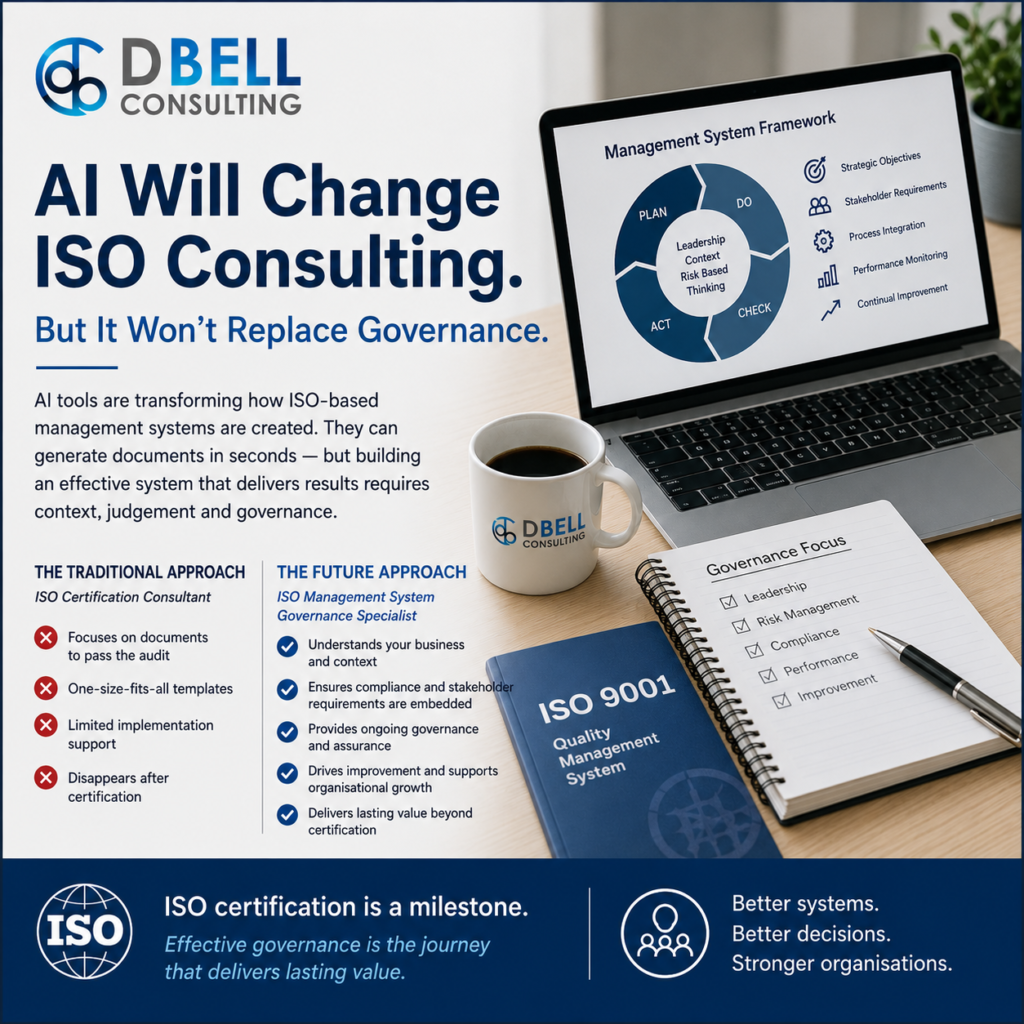
An ISO Certification Consultant can often be characterised as someone who:
- Focuses primarily on developing the documentation and records required to pass a certification audit.
- Has limited understanding of the organisation’s strategic objectives, operational realities, culture and unique risks.
- Applies standardised templates and methodologies with minimal adaptation to the organisation’s context.
- Struggles to support effective implementation and embedding of management system requirements.
- Disengages once certification is achieved, leaving the organisation to manage the system without ongoing governance or assurance support.
If document generation is the primary value proposition being offered, AI will inevitably become a significant competitor. The differentiator is not the ability to produce documents, but the ability to apply context, judgement and governance so the management system supports how the organisation manages real risks and obligations, and can adapt to change.
However, the question organisations should be asking is not:
“Can AI create documentation?”
The better question is:
“Can AI help us build an effective management system that supports organisational success?”
The answer is more complex.
The Opportunity (and Risk) of AI
There is no doubt that AI will become an increasingly valuable tool for management system professionals and consultants.
Used correctly, AI can accelerate document development, support gap assessments, assist with clause interpretation, generate training content and streamline many administrative aspects of management system development.
Yet AI is only as effective as the knowledge and judgement applied to its use.
Without appropriate expertise, organisations risk:
- Applying ISO requirements incorrectly to their unique context.
- Creating excessive documentation that adds bureaucracy but delivers little value.
- Failing to identify inaccurate or hallucinated AI-generated content.
- Overlooking customer, regulatory and stakeholder requirements, or incorrectly interpreting these (very dangerous for regulatory compliance).
- Implementing systems that appear compliant on paper but are ineffective in practice.
A management system should never exist solely to satisfy an auditor, which is the potential reality for organisations that will dive in head-first in this space.
Rather, the future role of AI is to support the organisation in achieving its objectives, managing risk, meeting stakeholder expectations and driving continual improvement. This relies on the involvement of organisational leaders who apply their knowledge of the organisation with sound decision-making.
No AI tool can independently determine what this should look like for a specific organisation.
That requires experience, judgement, governance and leadership.
The Role of the Management System Governance Specialist
As AI continues to mature, the future belongs less to the traditional certification consultant and more to the Management System Governance Specialist – the type of role DBell Consulting has deliberately sought to fulfil from the outset.
This role focuses on ensuring that management systems remain fit-for-purpose, effective and aligned with organisational needs long after certification has been achieved.
At DBell Consulting, governance and assurance are not add-ons after certification. They are central to how we support clients as a business partner, helping leadership understand whether the management system is controlling risk, meeting compliance obligations, satisfying stakeholder expectations and supporting strategic objectives.
Our approach is built around helping organisations maintain management systems that remain active, aligned with business operations and continuously improving over time. This includes governance oversight, performance monitoring, internal audits, compliance evaluation, and structured improvement activities that extend well beyond the certification audit itself.
An effective Management System Governance Specialist:
- Understands the organisation’s strategic direction and operational environment.
- Ensures customer requirements, compliance obligations and stakeholder expectations are embedded within business processes.
- Provides ongoing governance, assurance and advisory support.
- Monitors system performance and maturity.
- Identifies opportunities for improvement as the organisation evolves.
- Helps leadership make informed decisions based on management system outputs.
- Maintains certification readiness while focusing on broader organisational outcomes.
Most importantly, they help organisations derive genuine business value from their management systems.
Certification Is a Milestone, Not the Destination
Too many organisations treat ISO certification as the finish line.
In reality, certification should be viewed as a milestone within a much broader journey.
The true value of a management system is demonstrated through:
- Improved operational performance.
- Better risk management.
- Enhanced customer satisfaction.
- Stronger regulatory compliance.
- More informed decision-making.
- Greater organisational resilience.
These are not simply outcomes created by documentation. They are the result of strong leadership and commitment, supported by organisational capability, effective governance, informed decision-making, and a culture of continual improvement.
The Future Is Human Expertise Enhanced by AI
AI is here to stay.
It will continue to become more capable, more sophisticated and more accessible to organisations of all sizes.
But rather than replacing experienced management system professionals, AI will likely amplify the value of those who understand how to apply it effectively.
Specialists who will thrive in the future are not those who simply generate documents.
They are the professionals who can combine technical innovation with business understanding, governance discipline, assurance practices and strategic insight to help organisations build management systems that remain relevant, effective and valuable for years to come.
The future will increasingly involve AI-enabled governance professionals working as business partners, who help organisations build management systems that support sustainable growth, continual improvement and long-term organisational success.
Ready to Build More Than an Audit-Ready System?
Whether you’re establishing a new ISO-based management system, preparing for certification, or looking to strengthen the long-term effectiveness of an existing system, DBell Consulting provides practical management system development, and governance and assurance support that extends well beyond the certification audit.
To discuss your organisation’s needs, please visit our Contact Us page.